

The History of Positioning
The History of Positioning
The History of Positioning
Positioning didn’t emerge overnight—it was forged through decades of hard-won insight, cultural shifts, and category-defining ideas. This timeline traces the evolution of positioning from its origins to its lasting impact on marketing, showing how a clear idea in the mind became the most powerful force in business.
Positioning didn’t emerge overnight—it was forged through decades of hard-won insight, cultural shifts, and category-defining ideas. This timeline traces the evolution of positioning from its origins to its lasting impact on marketing, showing how a clear idea in the mind became the most powerful force in business.
Positioning didn’t emerge overnight—it was forged through decades of hard-won insight, cultural shifts, and category-defining ideas. This timeline traces the evolution of positioning from its origins to its lasting impact on marketing, showing how a clear idea in the mind became the most powerful force in business.

1960s

The Beginning of Positioning
The idea for positioning came from a young unknown advertising guy named Al Ries who founded his advertising agency Ries, Cappiello, Colwell in New York City back in the Mad Men era of the 1960’s. Al’s original idea was called the “rock.” Every brand needed a solid rock to differentiate itself from all the other brands in the category.
But not any rock. The “rock” had to be a word or concept that would be instantly accepted by prospects, like The leading toothpaste.
Al discussed the idea with the guys at the agency. One of his account executives, Jack Trout, suggested calling the rock a “position” instead. Al agreed. Al’s rock idea became positioning and it would change the world of marketing.
But not right away. The idea never went anywhere until 1972, when Al’s speech on positioning at the Sales Executives Club of New York got the attention of Rance Crain, editor of Advertising Age.
Rance suggested the topic of positioning would make a good series of articles for his magazine. Al, of course, agreed. The legendary three-part series of articles on positioning by Al Ries & Jack Trout was printed in April and May, 1972 – The Positioning Era Cometh.
1960s
The Beginning of Positioning
The idea for positioning came from a young unknown advertising guy named Al Ries who founded his advertising agency Ries, Cappiello, Colwell in New York City back in the Mad Men era of the 1960’s. Al’s original idea was called the “rock.” Every brand needed a solid rock to differentiate itself from all the other brands in the category.
But not any rock. The “rock” had to be a word or concept that would be instantly accepted by prospects, like The leading toothpaste.
Al discussed the idea with the guys at the agency. One of his account executives, Jack Trout, suggested calling the rock a “position” instead. Al agreed. Al’s rock idea became positioning and it would change the world of marketing.
But not right away. The idea never went anywhere until 1972, when Al’s speech on positioning at the Sales Executives Club of New York got the attention of Rance Crain, editor of Advertising Age.
Rance suggested the topic of positioning would make a good series of articles for his magazine. Al, of course, agreed. The legendary three-part series of articles on positioning by Al Ries & Jack Trout was printed in April and May, 1972 – The Positioning Era Cometh.
1960s
The Beginning of Positioning
The idea for positioning came from a young unknown advertising guy named Al Ries who founded his advertising agency Ries, Cappiello, Colwell in New York City back in the Mad Men era of the 1960’s. Al’s original idea was called the “rock.” Every brand needed a solid rock to differentiate itself from all the other brands in the category.
But not any rock. The “rock” had to be a word or concept that would be instantly accepted by prospects, like The leading toothpaste.
Al discussed the idea with the guys at the agency. One of his account executives, Jack Trout, suggested calling the rock a “position” instead. Al agreed. Al’s rock idea became positioning and it would change the world of marketing.
But not right away. The idea never went anywhere until 1972, when Al’s speech on positioning at the Sales Executives Club of New York got the attention of Rance Crain, editor of Advertising Age.
Rance suggested the topic of positioning would make a good series of articles for his magazine. Al, of course, agreed. The legendary three-part series of articles on positioning by Al Ries & Jack Trout was printed in April and May, 1972 – The Positioning Era Cometh.
1960s
The Beginning of Positioning
The idea for positioning came from a young unknown advertising guy named Al Ries who founded his advertising agency Ries, Cappiello, Colwell in New York City back in the Mad Men era of the 1960’s. Al’s original idea was called the “rock.” Every brand needed a solid rock to differentiate itself from all the other brands in the category.
But not any rock. The “rock” had to be a word or concept that would be instantly accepted by prospects, like The leading toothpaste.
Al discussed the idea with the guys at the agency. One of his account executives, Jack Trout, suggested calling the rock a “position” instead. Al agreed. Al’s rock idea became positioning and it would change the world of marketing.
But not right away. The idea never went anywhere until 1972, when Al’s speech on positioning at the Sales Executives Club of New York got the attention of Rance Crain, editor of Advertising Age.
1972

The Ad Age Article
Rance suggested the topic of positioning would make a good series of articles for his magazine. Al, of course, agreed. The legendary three-part series of articles on positioning by Al Ries & Jack Trout was printed in April and May, 1972 – The Positioning Era Cometh.
1972
The Ad Age Article
Rance suggested the topic of positioning would make a good series of articles for his magazine. Al, of course, agreed. The legendary three-part series of articles on positioning by Al Ries & Jack Trout was printed in April and May, 1972 – The Positioning Era Cometh.
1972
The Ad Age Article
Rance suggested the topic of positioning would make a good series of articles for his magazine. Al, of course, agreed. The legendary three-part series of articles on positioning by Al Ries & Jack Trout was printed in April and May, 1972 – The Positioning Era Cometh.
1972
The Ad Age Article
Rance suggested the topic of positioning would make a good series of articles for his magazine. Al, of course, agreed. The legendary three-part series of articles on positioning by Al Ries & Jack Trout was printed in April and May, 1972 – The Positioning Era Cometh.
1970s
Positioning was Rejected by the Establishment
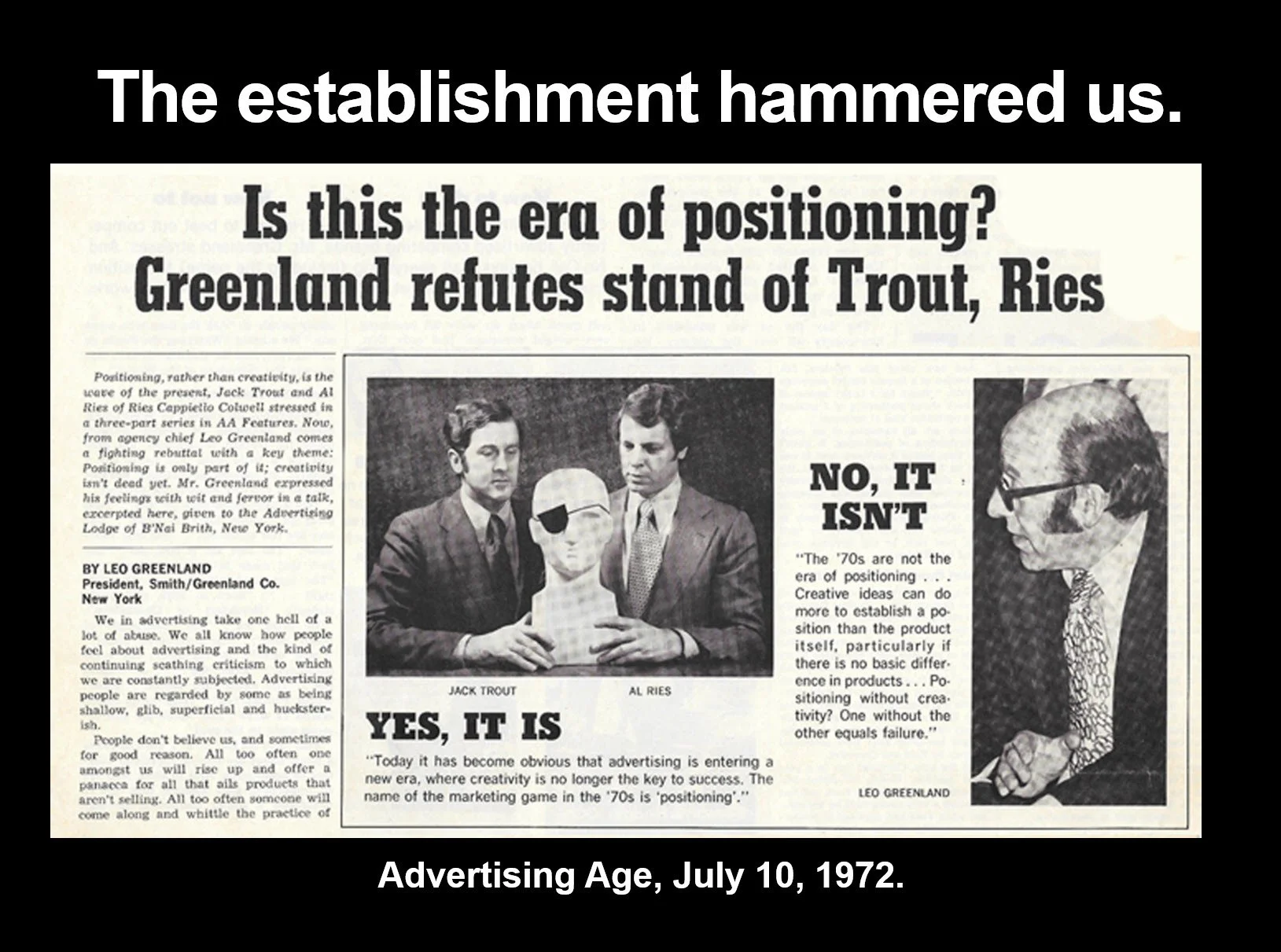
After the AdAge article ran, over the next few months hundreds of articles on the pros and cons of positioning were written. From David Ogilvy on down, everybody had an opinion on positioning. The article pronounced a new era for advertising and marketing. An era where creativity is no longer the key to success. The fun and games of the 1960’s man men era, gave way to the harsh realities of the 1970s. There were too many products, too many companies, too much marketing noise.
The positioning era had arrived. To succeed in an over-communicated society, a company must create a position in the prospect’s mind. A position that takes into consideration not only its own strength and weaknesses but those of its competitors as well. Advertising entered a new era where strategy was king. And into the 21st century, the theory of positioning is still as relevant as ever. The rise of the internet has made our lives more over-communicated than ever, cutting through the clutter takes an even narrower focus and singular position.
1970s
Positioning was Rejected by the Establishment
After the AdAge article ran, over the next few months hundreds of articles on the pros and cons of positioning were written. From David Ogilvy on down, everybody had an opinion on positioning. The article pronounced a new era for advertising and marketing. An era where creativity is no longer the key to success. The fun and games of the 1960’s man men era, gave way to the harsh realities of the 1970s. There were too many products, too many companies, too much marketing noise.
The positioning era had arrived. To succeed in an over-communicated society, a company must create a position in the prospect’s mind. A position that takes into consideration not only its own strength and weaknesses but those of its competitors as well. Advertising entered a new era where strategy was king. And into the 21st century, the theory of positioning is still as relevant as ever. The rise of the internet has made our lives more over-communicated than ever, cutting through the clutter takes an even narrower focus and singular position.
1970s
Positioning was Rejected by the Establishment
After the AdAge article ran, over the next few months hundreds of articles on the pros and cons of positioning were written. From David Ogilvy on down, everybody had an opinion on positioning. The article pronounced a new era for advertising and marketing. An era where creativity is no longer the key to success. The fun and games of the 1960’s man men era, gave way to the harsh realities of the 1970s. There were too many products, too many companies, too much marketing noise.
The positioning era had arrived. To succeed in an over-communicated society, a company must create a position in the prospect’s mind. A position that takes into consideration not only its own strength and weaknesses but those of its competitors as well. Advertising entered a new era where strategy was king. And into the 21st century, the theory of positioning is still as relevant as ever. The rise of the internet has made our lives more over-communicated than ever, cutting through the clutter takes an even narrower focus and singular position.
1970s
Positioning was Rejected by the Establishment
After the AdAge article ran, over the next few months hundreds of articles on the pros and cons of positioning were written. From David Ogilvy on down, everybody had an opinion on positioning. The article pronounced a new era for advertising and marketing. An era where creativity is no longer the key to success. The fun and games of the 1960’s man men era, gave way to the harsh realities of the 1970s. There were too many products, too many companies, too much marketing noise.
The positioning era had arrived. To succeed in an over-communicated society, a company must create a position in the prospect’s mind. A position that takes into consideration not only its own strength and weaknesses but those of its competitors as well. Advertising entered a new era where strategy was king. And into the 21st century, the theory of positioning is still as relevant as ever. The rise of the internet has made our lives more over-communicated than ever, cutting through the clutter takes an even narrower focus and singular position.
1970s
Then Positioning Took Off
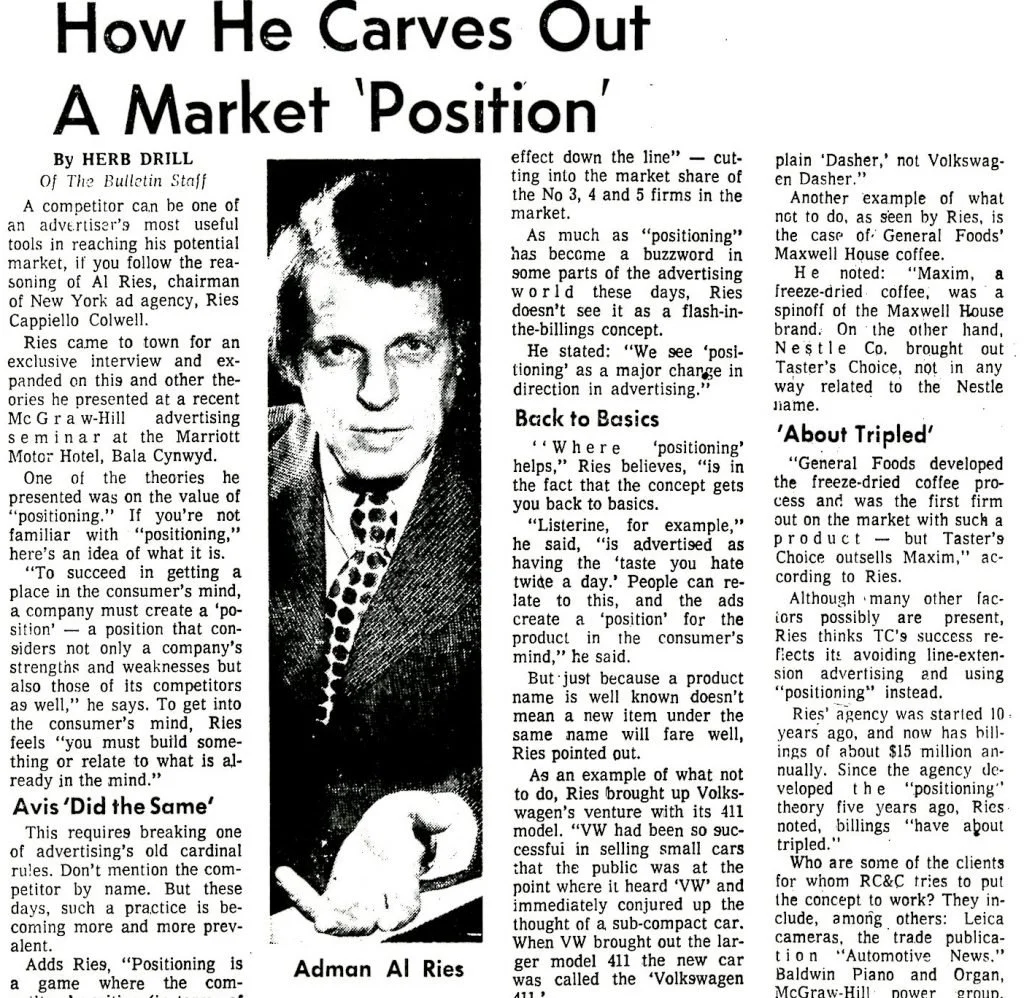
Over the next 10 years, Al ran around the world giving hundreds of speeches on positioning. The idea gained many followers and fans. The agency also gained more clients some for advertising but many more for positioning advice.
1970s
Then Positioning Took Off
Over the next 10 years, Al ran around the world giving hundreds of speeches on positioning. The idea gained many followers and fans. The agency also gained more clients some for advertising but many more for positioning advice.
1970s
Then Positioning Took Off
Over the next 10 years, Al ran around the world giving hundreds of speeches on positioning. The idea gained many followers and fans. The agency also gained more clients some for advertising but many more for positioning advice.
1970s
Then Positioning Took Off
Over the next 10 years, Al ran around the world giving hundreds of speeches on positioning. The idea gained many followers and fans. The agency also gained more clients some for advertising but many more for positioning advice.
Dec 1972
Positioning on the Front Page of the Wall Street Journal
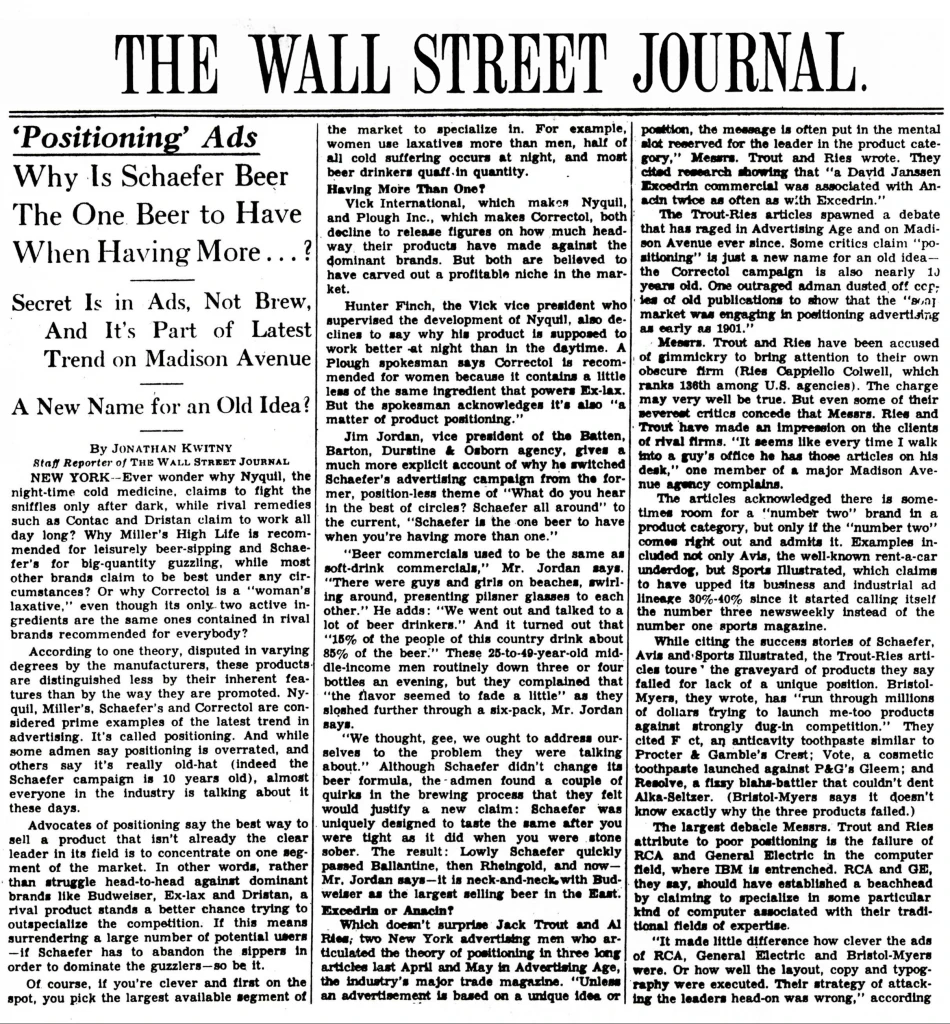
Positioning had arrived for good when it was written about in a column on the front page of the Wall Street Journal in December 1972.
Dec 1972
Positioning on the Front Page of the Wall Street Journal
Positioning had arrived for good when it was written about in a column on the front page of the Wall Street Journal in December 1972.
Dec 1972
Positioning on the Front Page of the Wall Street Journal
Positioning had arrived for good when it was written about in a column on the front page of the Wall Street Journal in December 1972.
Dec 1972
Positioning on the Front Page of the Wall Street Journal
Positioning had arrived for good when it was written about in a column on the front page of the Wall Street Journal in December 1972.
1973
Positioning Orange Booklets & The Success of the Ries Agency Business
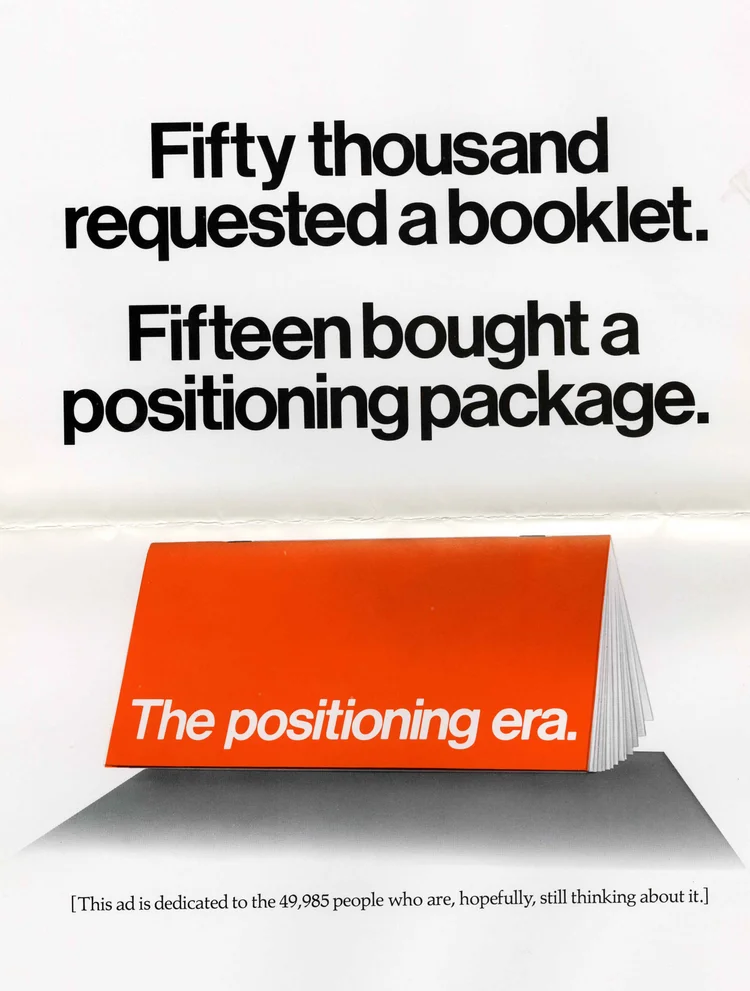
The articles ran in Advertising Age and made a big splash. But Al's best move was to reprint them in an orange booklet which was heavily promoted and given away for FREE to promote positioning and the agency.
1973
Positioning Orange Booklets & The Success of the Ries Agency Business
The articles ran in Advertising Age and made a big splash. But Al's best move was to reprint them in an orange booklet which was heavily promoted and given away for FREE to promote positioning and the agency.
1973
Positioning Orange Booklets & The Success of the Ries Agency Business
The articles ran in Advertising Age and made a big splash. But Al's best move was to reprint them in an orange booklet which was heavily promoted and given away for FREE to promote positioning and the agency.
1973
Positioning Orange Booklets & The Success of the Ries Agency Business
The articles ran in Advertising Age and made a big splash. But Al's best move was to reprint them in an orange booklet which was heavily promoted and given away for FREE to promote positioning and the agency.
1979
Trout & Ries
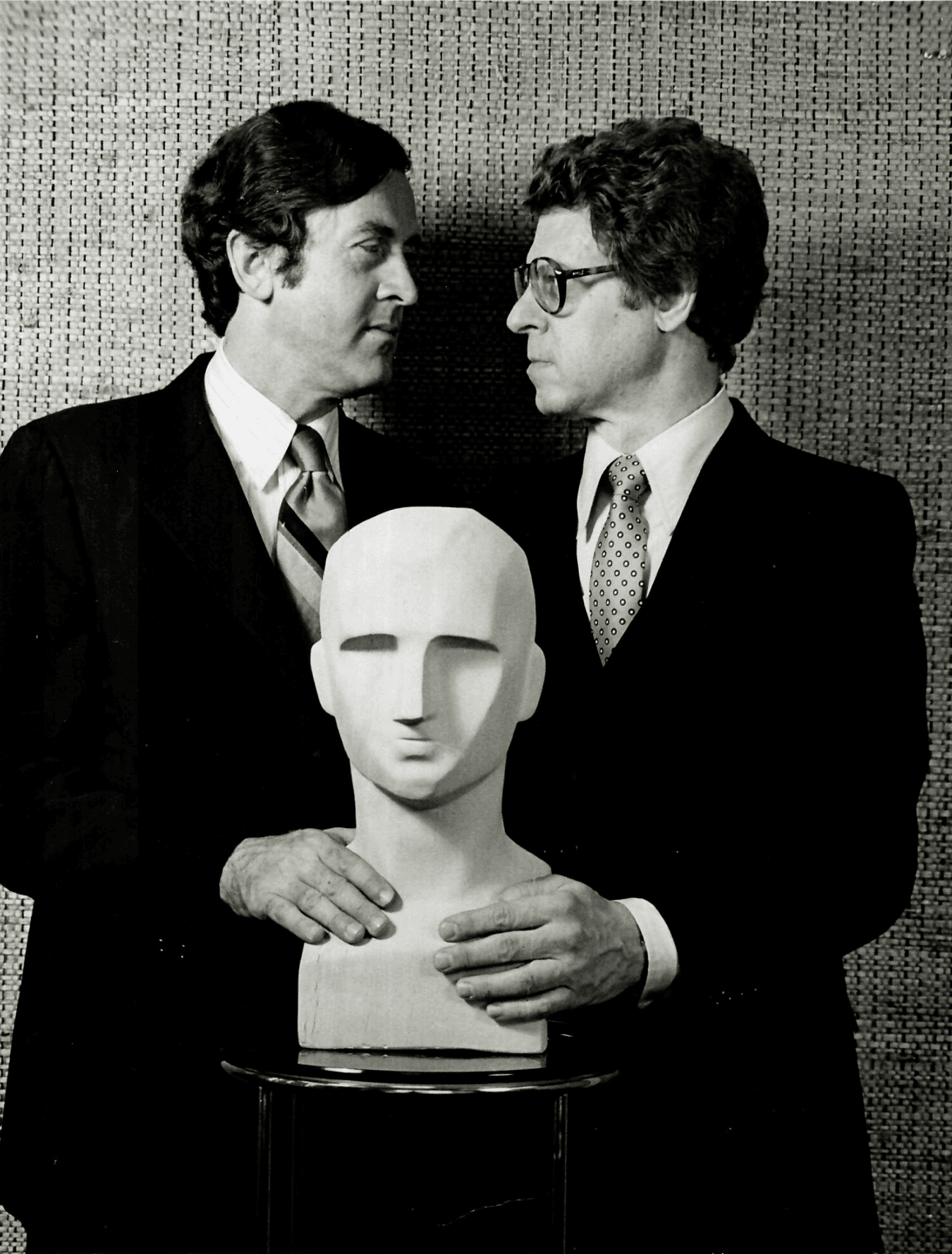
His former partners exited and the agency was renamed Trout & Ries. The book was Ries & Trout but they strategically decided that Trout would come first in the agency name since it was easier to find them in the white pages.
1979
Trout & Ries
His former partners exited and the agency was renamed Trout & Ries. The book was Ries & Trout but they strategically decided that Trout would come first in the agency name since it was easier to find them in the white pages.
1979
Trout & Ries
His former partners exited and the agency was renamed Trout & Ries. The book was Ries & Trout but they strategically decided that Trout would come first in the agency name since it was easier to find them in the white pages.
1979
Trout & Ries
His former partners exited and the agency was renamed Trout & Ries. The book was Ries & Trout but they strategically decided that Trout would come first in the agency name since it was easier to find them in the white pages.
1981

Positioning the Book was Published in 1981
In 1981, Positioning: The Battle for Your Mind was published. It has sold over 4 million copies worldwide and has been translated into 22 languages. Many say it is the world’s most famous book on marketing. In 2001, a 20th anniversary edition was published.
1981
Positioning the Book was Published in 1981
In 1981, Positioning: The Battle for Your Mind was published. It has sold over 4 million copies worldwide and has been translated into 22 languages. Many say it is the world’s most famous book on marketing. In 2001, a 20th anniversary edition was published.
1981
Positioning the Book was Published in 1981
In 1981, Positioning: The Battle for Your Mind was published. It has sold over 4 million copies worldwide and has been translated into 22 languages. Many say it is the world’s most famous book on marketing. In 2001, a 20th anniversary edition was published.
1981
Positioning the Book was Published in 1981
In 1981, Positioning: The Battle for Your Mind was published. It has sold over 4 million copies worldwide and has been translated into 22 languages. Many say it is the world’s most famous book on marketing. In 2001, a 20th anniversary edition was published.
2000s
Positioning Continues to be Read And Relevant Even into the 21st Century
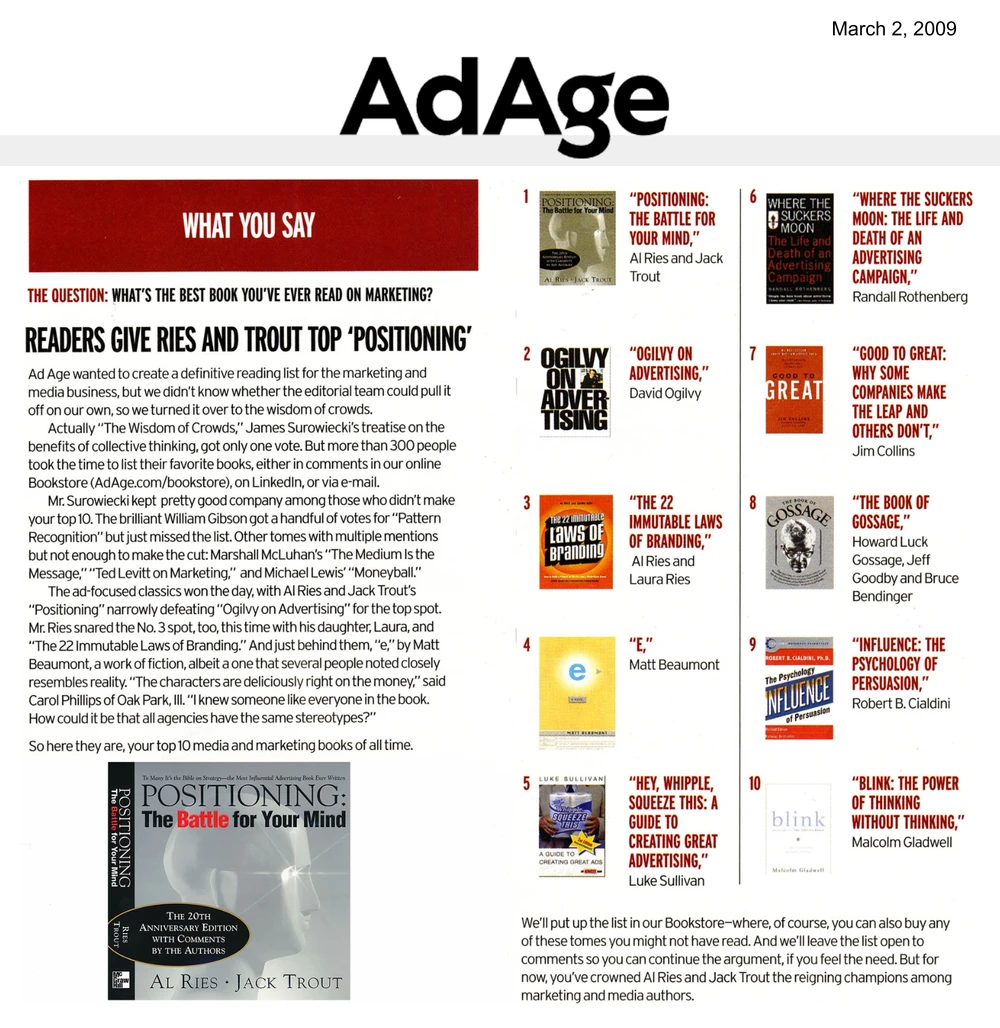
As marketing entered the 21st century, the principles of positioning proved timeless. In an era of digital noise and accelerating change, Positioning continued to be read, taught, and applied—reinforcing that while media evolves, the battle for the mind remains the same.
2000s
Positioning Continues to be Read And Relevant Even into the 21st Century
As marketing entered the 21st century, the principles of positioning proved timeless. In an era of digital noise and accelerating change, Positioning continued to be read, taught, and applied—reinforcing that while media evolves, the battle for the mind remains the same.
2000s
Positioning Continues to be Read And Relevant Even into the 21st Century
As marketing entered the 21st century, the principles of positioning proved timeless. In an era of digital noise and accelerating change, Positioning continued to be read, taught, and applied—reinforcing that while media evolves, the battle for the mind remains the same.
2000s
Positioning Continues to be Read And Relevant Even into the 21st Century
As marketing entered the 21st century, the principles of positioning proved timeless. In an era of digital noise and accelerating change, Positioning continued to be read, taught, and applied—reinforcing that while media evolves, the battle for the mind remains the same.
2018
Positioning in the 21st Century
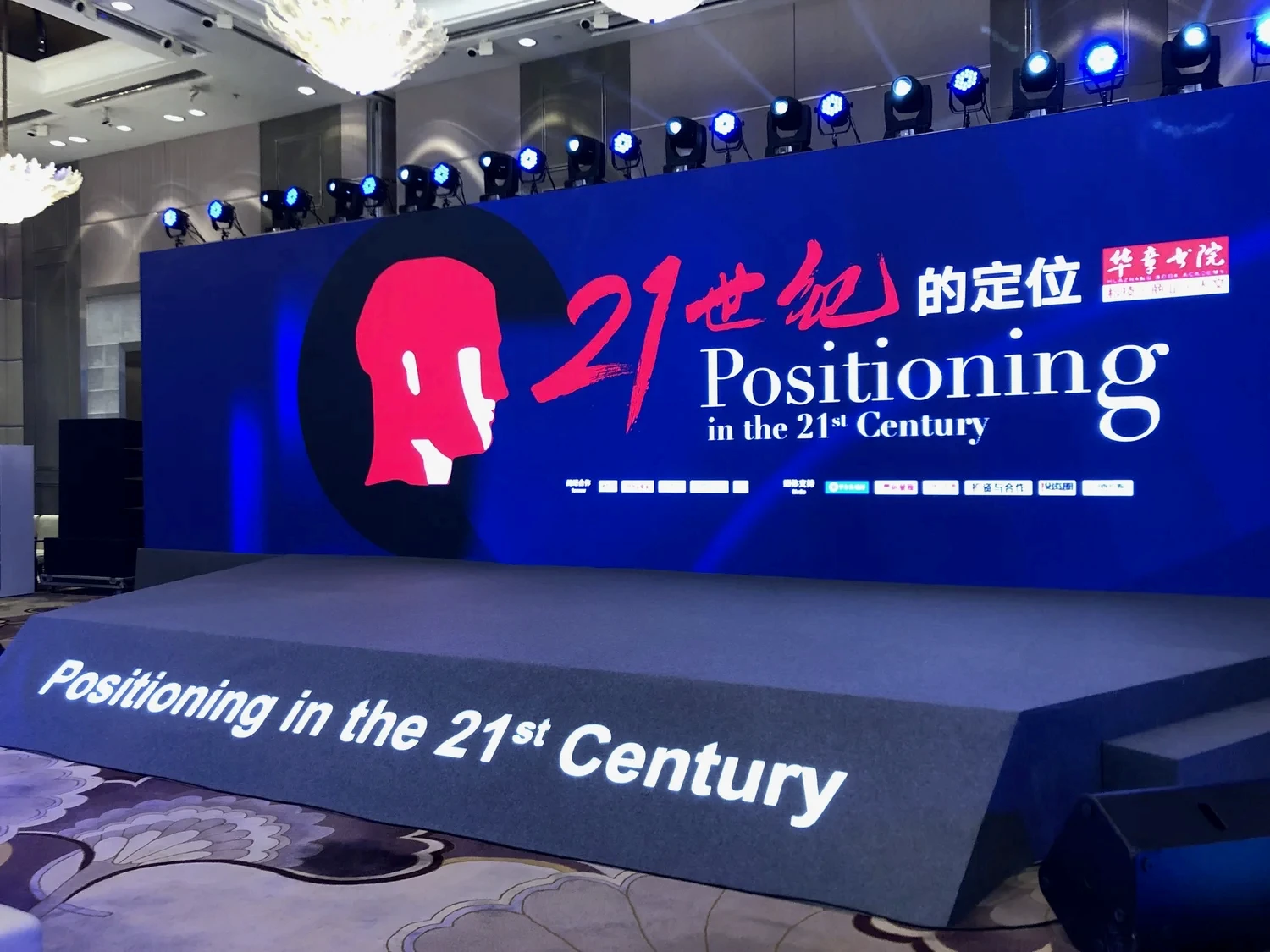
In the 21st century, positioning became a truly global discipline. With Positioning published in China in 2018 and growing demand for speaking engagements across the region, the ideas that reshaped marketing in the West found new relevance for a new generation of business leaders worldwide.
2018
Positioning in the 21st Century
In the 21st century, positioning became a truly global discipline. With Positioning published in China in 2018 and growing demand for speaking engagements across the region, the ideas that reshaped marketing in the West found new relevance for a new generation of business leaders worldwide.
2018
Positioning in the 21st Century
In the 21st century, positioning became a truly global discipline. With Positioning published in China in 2018 and growing demand for speaking engagements across the region, the ideas that reshaped marketing in the West found new relevance for a new generation of business leaders worldwide.
2018
Positioning in the 21st Century
In the 21st century, positioning became a truly global discipline. With Positioning published in China in 2018 and growing demand for speaking engagements across the region, the ideas that reshaped marketing in the West found new relevance for a new generation of business leaders worldwide.
RIES. Positioning Pioneers.
Ries © 2025
RIES. Positioning Pioneers.
Ries © 2025
RIES. Positioning Pioneers.
Ries © 2025
RIES. Positioning Pioneers.
Ries © 2025